
CTI Butler Solutions
Outcome-led pages showing how CTI Butler helps teams operationalise connected CTI knowledge, improve detections, reduce manual work, and support automation.
Overview
Solutions pages explain the team or business outcome CTI Butler supports.
If you want to understand why CTI Butler matters at a higher level before diving into a specific workflow, start here.
These pages are broader than the use-case pages. Each one focuses on an outcome security teams are trying to achieve, such as reducing repetitive research, improving detections, or making CTI more reusable across systems and automations.
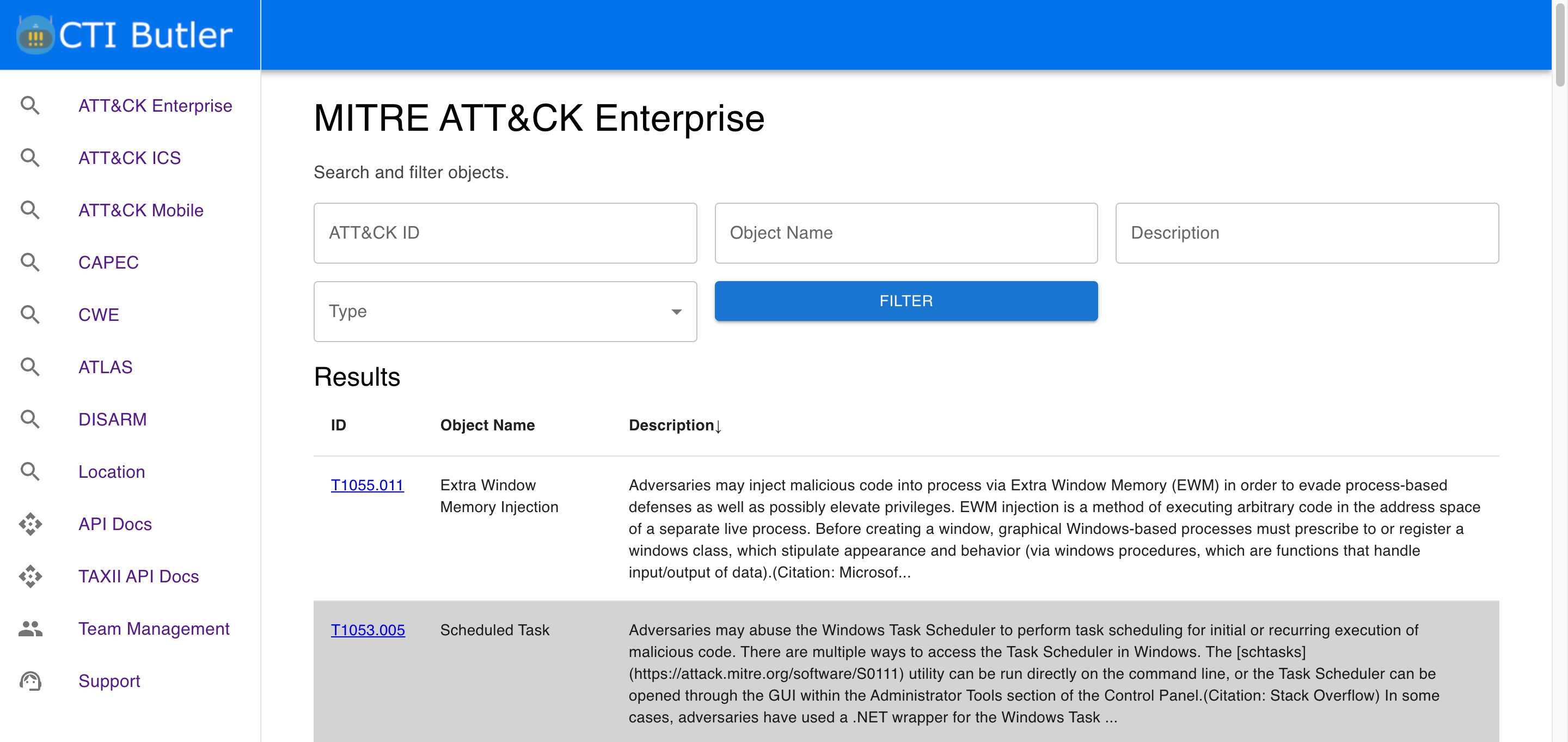
For CTI Butler, those outcomes usually begin with a simple problem: the knowledge exists, but it is spread across too many frameworks, too many interfaces, and too many manual steps. The solutions section shows how CTI Butler turns that fragmented reference material into something teams can actually work with at scale.
-
Operationalise Connected CTI Knowledge
Use structured knowledge bases as practical working context rather than isolated reference material.
-
Improve Detection and Hunting with CTI Context
Bring ATT&CK, related context, and inference into detection engineering and hunting workflows.
-
Reduce Manual CTI Research and Enrichment
Shorten repetitive analyst lookup work and make CTI enrichment more consistent.
-
Connect Threat Intelligence Across Frameworks
Move across ATT&CK, CAPEC, CWE, ATLAS, DISARM, and linked context from one platform.
-
Build AI-Ready Security Workflows
Give internal tools and AI agents a grounded CTI retrieval layer through standards-based outputs and APIs.